Laundry and Dry-Cleaning Terms: A Complete Industry Glossary for UK Businesses

If you are just getting started with a laundry or dry-cleaning business, there is a lot to learn. This isn’t limited to logistics or finances; we’re talking about laundrette terminology. What is a plant? How do P&D differ from WDF? New businesses might be unaware of what this is, but we’ll help you discover it all with this guide. This glossary covers the essential laundry industry terms used by laundrettes, dry cleaners, and commercial laundry operators with practical explanations for business owners and staff.

What Are Laundry Industry Terms?

Laundry industry terms are nothing but the words used to describe cleaning processes, garment care, business operations, and equipment. You may call them ‘go-to words’ used by the staff to understand instructions, explain services to customers, follow particular procedures, and so on.

This laundry terminology can vary according to the business type. For example, a self-service laundrette will usually deal with terms such as machine capacity and wash cycles, while a dry cleaner is more likely to use language around solvents, stain removal, and garment finishing.

Commercial laundries also use certain terms, especially when dealing with large quantities of linen, uniforms, towels, or other textiles. Anyone in this niche would want to get familiar with the terminology to make day-to-day work easier. Also, it helps staff understand instructions, communicate with suppliers, and keep routine tasks moving while avoiding unnecessary confusion.

Essential Laundry and Commercial Laundry Terms

Depending on the service, the work can include sorting, washing, drying, pressing, folding, and preparing items for the customer. The following terms cover some of the most common processes used by retail and commercial laundry businesses.

Common Laundry Terminology

Wash cycle

This programmed sequence indicates washing, rinsing, and spinning.

Pre-treatment

It specifically applies to textiles with stains before they go into washing.

Detergent

It is a cleaning product used to remove dirt and oils from fabrics.

Rinse cycle

At this stage, detergent is removed, and residue loosens with rinsing.

Extraction

This drying process helps remove excess water from textiles through spinning.

Sorting

It is about separating laundry based on the colour, fabric type, soil level, or care requirements.

Drying

This process helps remove moisture from washed garments or textiles.

Finishing

This indicates the process of preparing garments or linen through processes like pressing, steaming, or folding.

While these terms are relevant to most laundry services, their specific methods can vary according to the fabric and cleaning requirements.

Commercial Laundry Terms

The commercial laundry terms describe processes incorporated by laundrettes handling larger quantities. The following are the most common ones.

Commercial laundry

This is about the service processing textiles for commercial purposes, particularly serving businesses like hotels, restaurants, hospitals, or individual customers.

Laundry throughput

It indicates the quantity of laundry processed within a specific period.

Turnaround time

The processing time it takes between receiving laundry and completing the order.

Bulk washing

It dictates large-quantity textile processing on-demand or as per a commercial laundry contract.

Linen hire

Laundry businesses rent linen to commercial customers like hotels, hospitals, etc instead of wanting them to buy or manage their stock.

Textile handling

This includes moving, sorting, processing, and storing textiles safely.

Soil classification

Here, laundry is sorted according to the soil type or level.

Such laundry business terms are exclusively relevant to laundry providers serving hotels, restaurants, healthcare facilities, and other organisations.

Dry Cleaning and Laundrette Terminology Explained

Dry Cleaning and Laundrette Terminology Explained

Laundry and dry-cleaning businesses offer different services. Their terminology closely represents the processes and customer requirements handled. We’ve checked the laundry glossary by far, and here is an overview of the common dry-cleaning terms.

Common Dry Cleaning Terms

Dry-cleaning terminology represents methods used to clean suitable garments with solvents rather than conventional washing methods.

Solvent

It is a liquid used to dissolve certain soils during the dry-cleaning process.

Pre-spotting

This is a stain treatment before the garment enters the main cleaning cycle.

Spot cleaning

It helps remove a specific stain, mark, or dirt spot.

Garment inspection

The staff checks textiles for any residual stains, damage, and similar issues. This is attempted before and after cleaning.

Garment tagging

Each garment is tagged individually with a barcode or RFID system (whichever is implemented by the dry-cleaner) to track throughout processing.

Pressing

Heat and pressure are used to smooth and shape garments.

Steam finishing

Steam is used here to improve the garment’s appearance.

Garment packaging

The cleaned garments are ready for collection or delivery.

Dry Cleaning Terminology vs Laundry Terminology

Laundry terminology uses water and detergent while dry-cleaning uses solvents. Referring to the garment care labels helps staff select the ideal process and reduce risks related to shrinkage or colour loss.

The common laundrette terminology includes self-service laundry, select service wash, wash & fold, machine capacity, contactless payment, and collection & delivery. Understanding these terms helps staff explain services, payment options, and everything else more clearly to the customers.

What Is a Laundry Plant and How Does It Work?

A laundry plant handles linen and other textiles for businesses like hotels, hospitals, care homes, and more. The staff receives laundry bags, which they sort; then they go into processing (wash and dry), are pressed, folded, and checked before they are ready for delivery. Keeping track of the amount processed and the time each order takes helps the team spot bottlenecks before they become bigger problems. The machinery and working methods will depend on the type and size of the facility.

Summary: Laundry Business Terms, POS & Payment Reconciliation

Accurate POS reconciliation enables launderers and dry-cleaners to compare sales records with payment and settlement records.

This helps business owners outline issues like refunds, incorrect charges, or mismatched payments with records. Learning about everyday terms in laundry operations enhances staff’s efficiency whether they are processing garments, tracking customer orders, or receiving payments without losing sight of important details. When staff use the same language and follow uniformity with procedures, the chances of confusion are lower by default. It also makes conversations with customers and suppliers more straightforward. Overall, a random working day goes smoothly.

Contact Us to discuss POS reconciliation, payment management, or personalising an advanced EPOS system for laundry and dry-cleaning setup with Axcess IT.

book a demo

Laundry POS Software vs Manual Billing: Which Is Better for UK Laundrettes?

Handling laundry operations manually seems manageable when orders are low. But once your laundrette starts handling more garments daily, manual billing becomes inefficient and an impractical choice. This could be why laundry and dry-cleaning businesses search for “laundry POS software vs manual billing” to make the right choice from the beginning. Many laundromats still rely on basic billing methods like notebooks, paper invoices, or Excel sheets. They appear inexpensive initially but later create operational issues with business growth. This led to a demand for an efficient laundrette billing system for long-term growth, which we will discuss in this blog.

What is Manual Billing in a Laundry Business?

With manual billing for laundrettes, staff usually jot down the customer’s details, the items being handed in, and the service requested on a ticket or receipt. Some laundrettes use a spreadsheet or calculator alongside a basic receipt book to work out the final price. Once the order is checked, a staff member calculates the cost, takes the payment, and keeps a record for collection later.

What Is Laundry POS Software?

Laundry POS software is exclusively designed for managing sales, payments, routine business transactions, and beyond through a central system. This laundry EPOS system is designed to allow staff to select services, calculate prices, process payments, and issue receipts without manually working out every transaction.

It empowers laundrettes with much-needed automated laundry billing to create a structured process to record orders. Based on the system, laundromat owners may be able to manage customer information, track transactions, monitor sales, access useful information, create marketing campaigns, and do more that actually benefits their business.

Laundry POS Software vs Manual Billing: Key Differences

Here is the overview of the main differences between Laundry POS Software & Manual Billing.

FeatureManual BillingLaundry POS Software
BillingManual calculationsAutomated calculations
Order recordsPaper or spreadsheetsCentralised digital records
Payment processingOften separate from recordsIntegrated with POS workflow
ReceiptsHandwritten or basicDigital/printed options
ReportingManual preparationAutomated sales reporting
Order trackingMore difficultEasier to search and manage
Human errorHigher riskReduced through automation


| HIGHLIGHT: You’ll notice manual billing as cost-efficient but impractical when handling numerous garments regularly. Laundry POS software offers versatile features, automates billing, easily fits business processes, offers smooth accessibility, and can be scaled with business growth.

Common Problems with Manual Laundry Billing

The following list features the common problems with manual billing in laundrettes that trigger the need for a fix.

  1. Pricing and calculation errors – Manual calculations may have incorrect totals, specifically when the order contains several services or items with different prices. This seems less of a concern with advanced POS software.
  2. Difficulties in tracking orders – Your staff may not know how to track laundry orders when information they have to search required information across handwritten tickets, records, or spreadsheets. This is not possible with a centralised system like EPOS.
  3. Time-consuming administration – When you have limited staff, and they spend unnecessary time writing receipts, checking totals, and updating records rather than serving customers, you’re definitely not unleashing their potential.
  4. Limited visibility over processes – Reviewing sales, identifying loopholes, understanding the top-performing services, busy periods, etc could seem like a task with a manual system. A laundry POS system enables comprehensive accessibility across operations and the database to be used as actionable insights.
  5. Lost or incomplete records – Customer recordkeeping with handwritten notes or paper receipts can be easily misplaced, damaged, or difficult to read by someone else. Digital recordkeeping automatically resolves this issue.

These are only a few to list here; more could exist that can be almost overlapped with a smart laundry POS software like Clean Touch EPOS. Request a demo right away?

Is Laundry POS Software Worth It for a Small Laundrette?

Small laundrettes aim to reduce unnecessary staff work, maximise productivity, and process more transactions efficiently. This is what valuable laundry billing software or POS system offers. It enables automating calculations, receipts, and transaction recording. Such an approach is particularly useful when limited employees are handling several responsibilities at a time. EPOS system provides a structured workflow for enhancing service consistency.

Installing this system will take you closer to understanding how laundry POS systems reduce staff costs and allow you to focus on administrative tasks that matter.

What Should You Look for in Laundry Billing Software?

Laundromats should look for essential laundry EPOS system features to make the right choice. For a better take, make a list of required processes to match with the billing software features before purchase.

Focus on the ones supporting the actual workflow. For instance, a commercial laundry software should offer all-in-one features, empower smooth processing through RFID technology, facilitate customised reporting, and everything that appears relatable. Clean Touch EPOS system is designed to automate inventories, smartly control garment entry & exit, notify customers on laundry process updates, and more. Your software should also be staff-friendly because complicated interfaces can create operational issues, which become time-consuming instead of easing tasks. Consider the scalability of the billing software to accommodate future requirements with increasing transaction volumes or services.

How Axcess IT Clean Touch EPOS Can Help Your Laundry Business?

Axcess IT Clean Touch EPOS is a centralised system providing broader accessibility to UK laundrettes with valid reasons to let go of manual billing processes. It brings transactions and billing into an EPOS till system to allow businesses to create a more consistent workflow. Its benefits include inventory, stock, staff, customers, marketing, or anything under laundromat management.

The benefits of automated laundry billing can make everyday transactions quicker and easier to manage. Staff can process payments, keep customer records organised, and avoid many manual calculation errors. Even small or new laundrettes can use a single platform to manage sales and payments more efficiently.

If you were planning to replace manual billing or upgrade your current setup, Contact Us to discuss how Clean Touch EPOS can fit into your setup.

book a demo

What Is Garment Tracking in Dry-Cleaning Business & How Does It Work?

If you are trying to understand what garment tracking is in the dry cleaning business & how it works, you are in the right place. In this guide, we will share the basics and more regarding the garment tracking system, the way it helps dry cleaners, its benefits, and so on.

What is Garment Tracking in Dry Cleaning?

A garment tracking system for dry cleaners simplifies the need for tracking garments throughout cleaning, washing, drying, sorting, folding, and delivery. It eliminates the need for manual checks that are time-consuming. This system tracks each garment through a unique identifier assigned using a barcode or RFID tag. The staff is trained to use the garment tracking feature for identifying orders and knowing which customer they belong to. It mainly helps when a bulk of similar garments are being processed at the same time.

How Does Garment Tracking Work? [Step-by-Step Guide]

The dry-cleaning garment tracking system generally follows the garment through vital stages of the business. Let us understand it better with this stepwise guide on how the garment tracking mechanism works.

Step: 1 – Booking the order

The staff enters customer details and adds the garments to a new order for the system to keep the information together for the items to be identified at once.

Step: 2 – Tagging the garment

The garments entering processing are assigned a unique barcode or RFID tag. This identifier is unique to the garment or order, which makes it easier for the staff to trace them without requiring any handwritten notes or memorising.

Step 3 – Moving through the cleaning process

As the garment moves through processes, staff can scan its code, or automated updates are available (through RFID) for a clearer idea of where it has reached.

Step 4 – Sorting the order

Once the cleaning part is complete, the garment is matched with the order number assigned to the customer and transferred to the storage or collection bin.

Step 5 – Ready for collection or delivery

When the customer arrives, staff can quickly locate the order and hand over garments without any mistakes. These items can be verified against the order before handing over/sending out for delivery.

Barcode vs QR Code vs RFID for Garment Tracking

Let us share an overview of the key differences between barcode & RFID garment tracking systems.

Barcode technology is the traditional or standard order-tracking system. It is best suited for small dry cleaners. QR code facilitates a flexible digital identification feature, ideal for storing more information than a barcode. It can be scanned using different devices, including smartphones.

RFID Garment tracking is an appropriate choice for large-scale dry cleaners where fast order processing and automated tracking work in sync. This technology uses radio frequency to identify the tagged items.

| HIGHLIGHT: The appropriate choice for dry cleaners depends on the workflow and order volume. Barcode systems may seem practical options for small to medium-sized stores. RFID technology is a better choice for businesses handling a large number of garments.

Benefits of Garment Tracking for Dry Cleaners

A modern garment tracking system offers several advantages that ease dry-cleaning business management. Here are a few of the many practical benefits it provides.

  1. Improves staff efficiency by letting them easily identify order status without any manual entries.
  2. Reduces chances of misplaced and missed items (and thefts too!).
  3. Leads to faster results whenever any order-related information is required.
  4. Improves overall processing control. Any garment can be tracked throughout the cleaning stages.
  5. Facilitates greater accountability regarding how orders move through the business.
  6. Allows tracking each garment individually regardless of order volume.
  7. Helps businesses provide better customer service.

What Should a Garment Tracking System Include?

We are listing the essential features of a garment tracking system in the UK. They are far beyond the RFID technology alone. The system should naturally fit into the existing workflow and be flexible enough to handle a wider workflow.

  • Unique order or garment ID
  • Technology support (barcode or RFID)
  • Order status tracker
  • Fast fetching of customer and order records
  • Easy scanning and searching features
  • Garment and order history is always handy
  • Collection and delivery management
  • EPOS software integration
  • Staff accessibility levels and accountability
  • Administrative reporting for a wider view of business insights

These are the basics expected from a garment tracker. You may look for custom features as per your business requirements, particularly when getting yours personalised with Axcess IT.

How does the Dry Cleaning EPOS Software Assist with Garment Tracking?

Garment tracking is becoming a new essential for dry-cleaners. For better control, this feature is paired with a Dry Cleaning EPOS System. Together, they offer centralised access to vital information related to inventory, staff, garments, customers, orders, and more without leaving the platform.

For instance, Axcess IT EPOS for dry cleaners is designed to help businesses manage entire operations from one platform. Our dry-cleaning EPOS system supports a wide range of specifications including order booking, tracking, payment, customer accounts, staff management, expenses, invoicing, and more. Dry-cleaners can also track staff clock-ins, assign access as per employee grade, customise reports for marketing campaigns, send SMS or Emails to customers, and do much more.

How Does the Axcess IT Garment Tracking System Make a Difference?

Your business needs this digital tool for greater control and visibility across routine operations. Axcess IT garment tracking system is here to deliver the same while keeping tracking linked to wider EPOS operations. This helps dry-cleaners maximise staff productivity and avail insights on all aspects of the business.

We also have the Cleanermatix system that enables factories to make entries of the incoming work, manage washing, processing, and assembly on the conveyor/flatwork system either manually or using Sortexx Bins. It is specifically designed with excellent features dedicated to larger premises requiring higher levels of efficiency and accuracy. If you’re an established dry-cleaner with a large store managing thousands of orders weekly, don’t miss out!

Don’t you want to experience this advanced garment tracking system? Reach out to us today or register for a free trial to see how Axcess IT Dry-Cleaning EPOS can help your business grow.

FAQs

What is a garment tracking system?

A garment tracking system is a combined technology in use. It includes software and identification technology to monitor garments throughout processing.

Is RFID garment tracking suitable for dry cleaners?

Yes. Radio Frequency Identification (RFID) tags are used by established dry cleaners processing high-volume garments daily.

Does garment tracking help manage garment inventory?

Yes. Garment inventory tracking makes it more convenient to track individual garments and order records, identify misplaced items at the exact point during processes, and retrieve customer information faster.

Can I integrate garment tracking with an EPOS system?

Mostly, dry-cleaners can integrate garment tracking with an EPOS system for centralised tracking whenever & wherever required.

How can I get started with a garment tracker?

You can get started by looking at the order volume currently processed by your business, the number of orders received in a month, and the tracking challenges faced. Speak to the expert EPOS provider to discuss the best possible solution.

book a demo

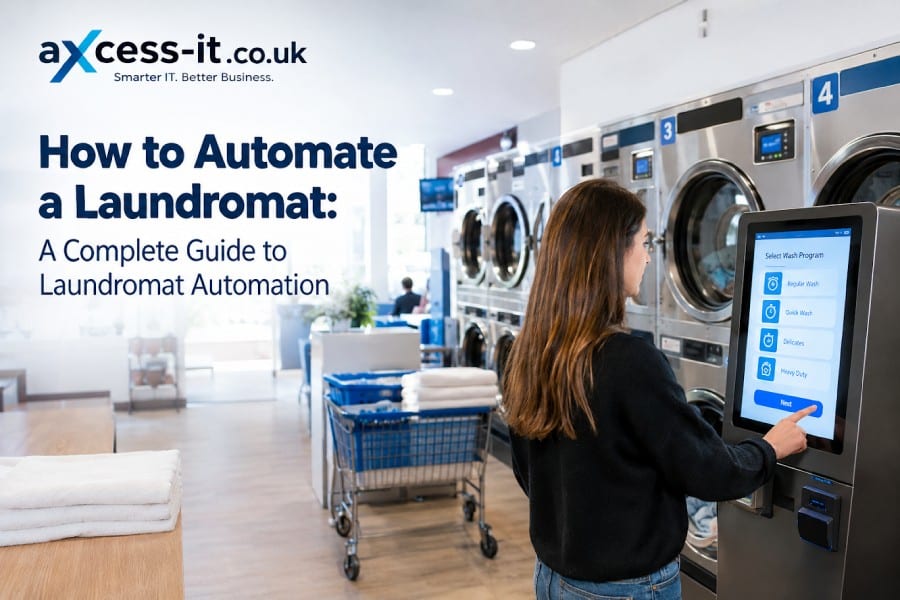
How to Automate a Laundromat: A Complete Guide to Laundromat Automation

Modern-day laundry automation is a game-changing strategy, highly recognised and adapted by successful operators in 2026. If you haven’t incorporated this technology advancement in your setup and are wondering how to automate a laundromat, this complete guide is all you need at the moment. It is equally important not to assume automation will take over the business entirely but to remove low-value, repetitive tasks that keep you/your staff from doing things that actually support business growth. This technology helps to shift focus on what matters, like customer relationship management, upselling services, solving problems requiring human help, and so on.

The UK laundromat industry underwent many changes over the last year compared to the previous decade. With new investors entering the market, customer expectations are rising, and laundrettes operating with the same old workspace management may struggle to compete.

Let us discuss more about what automation looks like for laundry and dry-cleaning businesses. We will also share the benefits, how to implement, and more that relates.

What Is Laundromat Automation?

Laundromat automation is not about a single piece of equipment handling it all. It is all about synchronised functions of software, connected equipment, and digital systems to streamline routine business processes. Depending on the business requirements, it can also include payment processing, order management, garment tracking, notifying customers, stock control, and monitoring machinery.

This does not mean you should cut your staff but rather give your employees better tools to manage work efficiently.

  • How does laundromat automation work?

It typically connects several operational processes through a centralised system. For instance, an order can be recorded digitally, tracked throughout washing till finishing, and updated when ready for collection/delivery. The EPOS or connected payment system provides greater transaction visibility. Operational data enables owners to understand sales, workload, and machinery utilisation. Its exact setup differs according to the size and services offered by a laundromat.

Why Automate Your Laundromat?

Laundromat automation is specifically helpful when the premises have a lot of repetitive, time-consuming tasks. A digital system can help in standardising these processes and make it easier to access useful information.

Key Benefits of Laundry Business Automation

The following are the major benefits of incorporating automation for your laundry & dry-cleaning business.

  1. Fewer manual administration
  2. Improved visibility of orders and customers
  3. More convenient and smooth payment processing
  4. Better administrative oversight
  5. Easy to design marketing campaigns
  6. Reduces chances of manual errors
  7. Tailored insights accessible as needed

What are the Core Areas of Laundry Automation?

Automating payments and order management are the core areas of laundry automation. Offering reliable and secure digital payment facilities makes it easier for customers to pay while making it convenient for business owners to record transactions. The staff don’t need to record them manually. By automating order management, the system organises customer requests from booking till completion. When such basic tasks work in sync, staff and owners have a broader view of the processes, payments, and attention-requiring tasks.

Use an EPOS System to Centralise Your Laundromat

EPOS system is the centralised platform for managing sales and other business activities. Instead of keeping transactional information separate, a suitable EPOS solution allows access to relevant information together. It ultimately provides a convenient way for your staff to process orders. This is particularly useful when the laundromat offers additional services because the business requires more control across processes than self-service washing/drying.

  • What to Look for in an EPOS System?

Look for an EPOS system that suits your existing operations rather than preferring one according to the number of features offered. Tick all the basics your business needs for smooth daily operations and administrative control. The key features to look for include order management, payment-related support, reporting, integration, and ease of use together with other business systems.

Also ensure the provider facilitates training and ongoing support. If your staff don’t understand the system, the system will become more time-consuming than time-efficient.

Laundry Automation Solutions for Customer Management

It gets more convenient to manage customers when orders and customer information are digitally stored. Automated Order Management helps staff organise work inflow while Automated Garment and Linen Tracking provides broader visibility of individual items throughout laundry processes.

Businesses offering laundry pickup and delivery services can also use digital systems to synchronise collections, deliveries, and order updates. It is also possible to manage inventory and stock, allocate work to staff, coordinate routine business operations, and beyond through automation. Overall, it becomes more efficient for business owners to manage staff, customers, marketing campaigns, and gain valuable insights while reducing repetitive workload.

How Laundromat Operators Can Implement Automation?

Laundromat operators can implement automation by choosing the right technology and integrations. The first step is identifying how customers place orders (online, calls, or walk-ins), the most preferred payment options, garment processing, and how the completed orders are returned (pickup by customers or delivered by the business).

Understanding these basic operations helps you choose technology that works together. Integrations should not be missed because disconnected platforms can create duplicate entries, further making it hard to maintain accurate records. Don’t overlook your business’s future requirements either.

Automating Maintenance and Machine Monitoring

Laundromat Automation

Machine monitoring helps businesses identify operational issues earlier and maintain equipment’s performance records. Automation with commercial machine maintenance supports preventive servicing and reduces avoidable disruptions to laundry processes.

A Step-by-Step Plan to Automate Your Laundromat

Below are the general steps that may help automate your laundromat.

  1. Review your existing system or laundromat processes
  2. Start with the processes that can deliver routine task benefits upon automation
  3. Choose compatible technology that seamlessly integrates with the EPOS system, payment, order management, and more
  4. Train your staff with the new workflow
  5. Test the system for a few days before the final implementation
  6. Monitor staff and operational performance post-automation

Wrapping up

Laundromat operators now know that automation is not about replacing staff but about creating a suitable work environment for managing routine operations more efficiently. What works is the appropriate combination of an EPOS system, payments, order management, and operational software. They provide greater visibility together with everyday task consistency.

If you are looking for an upgrade and don’t have modern technology employed, why not request a laundry EPOS demo at Axcess IT today? Their customizable Clean Touch EPOS system can help enhance routine and administrative laundromat operations as expected. Contact us right away.

FAQs About Laundromat Automation

How to automate a laundromat?

The simplest way to automate a laundromat is to identify repetitive tasks and introduce suitable technology for payments, order & customer management.

Is laundromat automation suitable for small laundromats in the UK?

Yes. Even a small laundromat in the UK can use automation to cut down on routine tasks and improve staff productivity without paying for unnecessary technology.

Can automation reduce staffing requirements?

To some extent, yes. Automation helps in handling repetitive tasks, but you will still need staff to handle customers in person and deal with tasks requiring the human brain.

What equipment can be connected to an automated system?

It widely depends on the size and setup of the laundrette. The automated system may be connected with your EPOS, payment facilities, commercial laundry equipment, and other software used for smooth business management.

How long does it take to automate a laundromat?

The automation timeline differs according to the laundromat size, integrations, equipment, etc.

What should I look for in a laundry management system?

It is essential to prioritise ease of use. Features like EPOS and payment integrations, custom reporting, and scalability are also expected, with reliable support (whenever needed).

How much does laundromat automation cost in the UK?

The cost varies as per the laundromat business requirements, software, equipment, integration, and automation level.

book a demo